15 Specialized Agents.
One Coordinated Team.
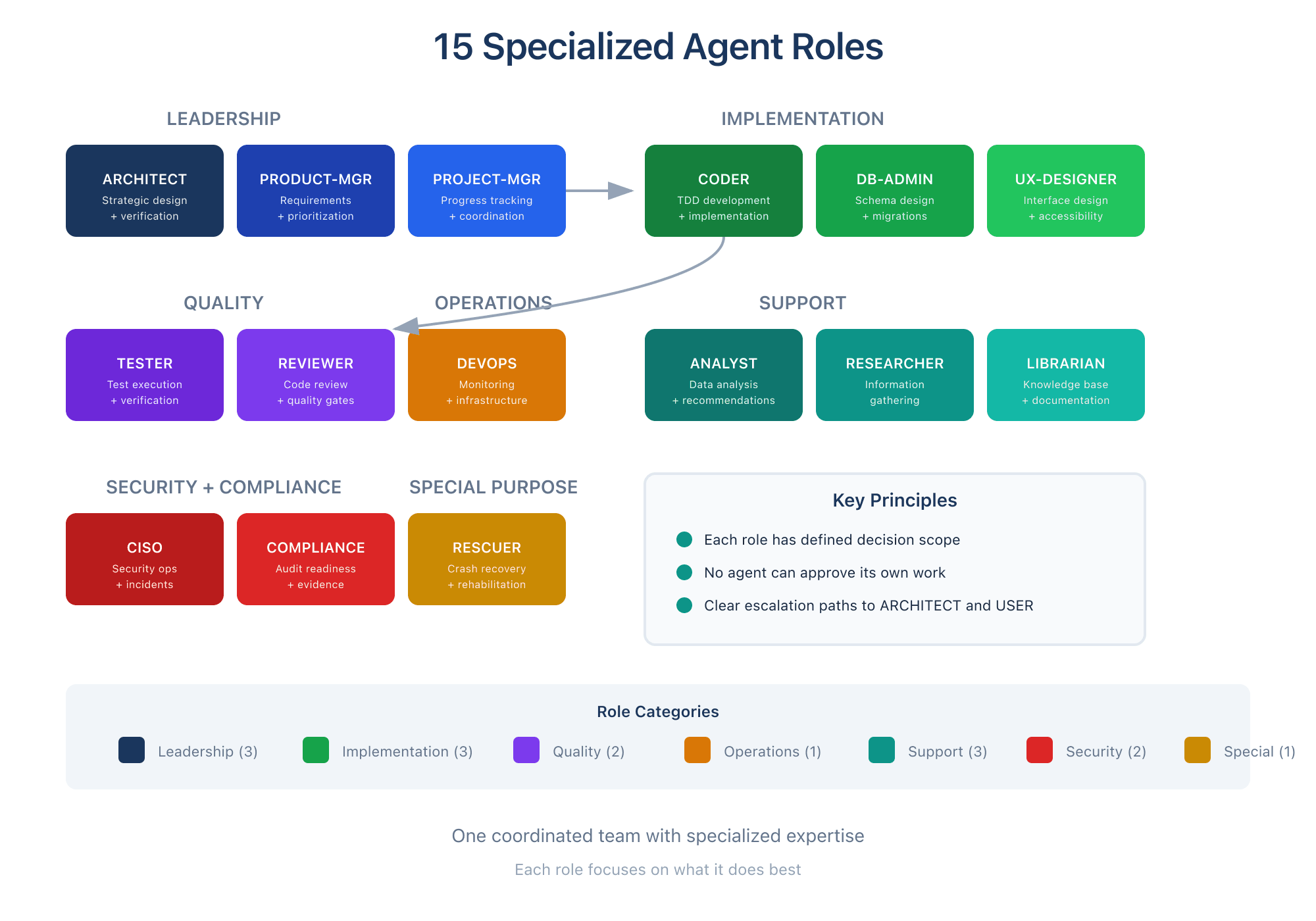
AI-AMP orchestrates specialized agents with defined decision scopes, clear escalation paths, and strict accountability. Each role knows what it can decide, what requires approval, and who to escalate to.
The Problem with Single-Agent AI
Most AI coding tools use a single model for everything—planning, coding, testing, reviewing. That's like asking one person to be architect, developer, QA, and code reviewer simultaneously.
The Result:
- No decision boundaries or escalation paths
- Self-approval with no independent verification
- No recovery when context is lost
- No traceability from vision to implementation
The AI-AMP Approach
Each role has a defined decision scope: what it can decide autonomously, and what requires escalation. ARCHITECT verifies CODER work independently. CODER writes tests first (TDD mandatory). CISO classifies vulnerabilities. COMPLIANCE validates evidence.
When an agent crashes, RESCUER reconstructs context from session artifacts and creates synthetic handoffs for seamless recovery.
All 15 Agent Roles
Leadership Roles
ARCHITECT
Purpose: Strategic orchestration and system design
Creates visions, decomposes work into tickets, delegates to implementation roles, performs independent verification before USER approval.
PRODUCT-MGR
Purpose: Requirements and feature prioritization
Gathers user requirements, writes user stories with acceptance criteria, prioritizes by business value. Defines WHAT to build.
PROJECT-MGR
Purpose: Progress tracking and coordination
Tracks work across tickets and agents, identifies blockers, coordinates cross-agent activities, reports status to stakeholders.
Implementation Roles
CODER
Purpose: TDD implementation and feature development
TDD mandatory: (1) Write tests first, (2) Run tests - verify FAIL, (3) Implement minimum code to pass, (4) Run tests - verify PASS, (5) Refactor if needed, (6) Build must pass with 0 errors before handoff.
DB-ADMIN
Purpose: Database schema and migrations
Designs schemas, writes and tests migrations with rollbacks. BACKUP FIRST is mandatory. Maintains agent lifecycle functions.
UX-DESIGNER
Purpose: User experience and accessibility
Designs interfaces and flows, maintains style guides, ensures WCAG 2.1 AA accessibility compliance.
Quality Roles
TESTER
Purpose: Test execution and verification
Executes automated and manual tests. Every result requires evidence. Defects documented with reproduction steps and severity (CRITICAL/HIGH/MEDIUM/LOW). Verification proof required for passes.
REVIEWER
Purpose: Code review and quality gates
Reviews code against requirements, verifies tests pass, checks for security issues. Never approves own work.
Operations Roles
DEVOPS
Purpose: Monitoring and infrastructure
Monitors daemon health, manages Git artifacts, generates daily/weekly/monthly reports, tracks system health and anomalies.
Support Roles
ANALYST
Purpose: Data analysis and recommendations
Analyzes patterns and gaps, formulates evidence-based recommendations. Every recommendation requires supporting evidence.
RESEARCHER
Purpose: Information gathering only
Collects data from sources, documents findings with citations. Gathers facts only - does not analyze or recommend.
LIBRARIAN
Purpose: Knowledge and documentation
Maintains Run Book, KB articles, role prompts, and HOWTOs. Enforces documentation standards (tables ≤65 chars, no emojis).
Security & Compliance Roles
CISO
Purpose: Security operations and incidents
Monitors security alerts, classifies vulnerabilities (SEV0-3), coordinates incident response. SEV0: active breach (immediate). SEV1: critical vulnerability (24h). SEV2: high risk with workaround (1 week). SEV3: low risk (2 weeks). SEV0/SEV1 require ARCHITECT approval.
COMPLIANCE
Purpose: Audit readiness and evidence
Collects and validates evidence artifacts, maps controls to regulatory requirements, maintains traceability matrices (Regulation → Requirement → Design → Code → Test → Evidence). Assesses audit readiness and identifies compliance gaps.
Special Purpose Roles
RESCUER
Purpose: Crashed agent recovery
Rehabilitates agents that crashed without handoff. Reconstructs context from session files with confidence scoring (90+ HIGH, 70-89 MEDIUM, <70 LOW). Creates synthetic handoffs with source annotations for seamless recovery.
AI-AMP vs Single-Agent Tools
| Aspect | Single Agent | AI-AMP (15 Agents) |
|---|---|---|
| Specialization | One model does everything | 15 specialists with defined scopes |
| Decision Authority | No boundaries | Can decide vs must escalate |
| Verification | Self-reviews | Independent verification required |
| Code Quality | Best effort | TDD mandatory, 0 build errors |
| Audit Trail | Limited | Vision to test traceability |
| Recovery | Context lost on crash | RESCUER reconstructs context |
| Security | Afterthought | CISO + COMPLIANCE built in |
What Do You Think?
We're building AI-AMP for enterprise teams. Your feedback shapes what we build next.